Author: Anu Kusumakar Kadri

  • Amazing birds and truly amazing facts of Birds-Indian Paradise Flycatcher

    Introduction of Indian Paradise Flycatcher

    The Indian Paradise Flycatchers (Scientific Name :Terpsiphone paradisi) They are found  naturally in Asia in extremely large range.
    Indian Paradise Flycatchers are a beautiful bird. Size of adult Indian Paradise Flycatchers are between 18 to 22 cm. The length of the tail (adult male) is between 20 to 24 cm, with two central tail feathers growing up to 30 cm long drooping streamers.  Their wings are between 3.4 – 3.6 inches (86 – 92 mm) long.


           Males paradise flycatcher is found  in two morphs or phases, one have a rufous or glossy chestnut upper plumage and another with a white or dirty white plumage. The edges of the wings and tail feathers are sometimes black.Intermediates of both forms also exist. Some birds also molted from rufous into white plumage.

    Head of Indian Paradise flycatcher is glossy black with a glossy black crown and crest. They have short legs and sit very upright whilst perched prominently. The bill is round and sturdy and bluish black in color. Eyes are black, and the eye rings are bluish black.

          Male Indian Paradise flycatcher have long tail feathers. The long, narrow tail is rounded at the tip, except for the two streamers that droop. This central pair of tail feathers growing up to 20 to 30 cm long drooping streamers. The females are only 20 cm long and lack the tail streamers

    Female are rufous on the back with a greyish throat and underparts, and they have short tail with rufous wings and a black head. Females have greyish throat and underpart, the eyes are black with bright bluish rings around the eyes.

           Young males  lack the two very long central tail feathers, which they acquire in their second or third year.At juvenile stage they look very much like females. Their bodies and wings are rufous and the head, including the throat, is completely black. They have a black throat and blue-ringed eyes.


    Habit and habitat

     They prefer thick forests and well-wooded habitats. They also found in forest, gardens, shady groves, light deciduous jungle, and bamboo ravines. They are migratory and spend the winter season in tropical Asia.

    Distribution
    They found in India, Sri Lanka, and Turkestan to Manchuria and west to the Malay Archipelago where they inhabit the islands of Sumba and Alor. There are resident populations in southern India and Sri Lanka, hence both visiting migrants and the locally breeding subspecies occur in these areas in winter

    Call
      They are quite noisy birds uttering sharp skreek calls. They also call che-che or che-chew or sharp zweet…zweet….
     Food
         Indian paradise flycatcher is a insectivorous bird. They feed on insects, butterflies and flies. They usually hunt in the understory of densely canopied trees.

    Breeding and Nesting

    Indian Paradise Flycatcher are socially monogamous.Nesting and breeding season is between March to July. They make a cup like nest  by twigs bound together with spider webs and is usually situated on the end of a low tree branch. Both male and female take part in nest-building.

          A clutch usually consists of 3 – 4 eggs, which are  pale creamy pink with reddish brown in colour. Incubation for about 21 – 23 days. Both parents take part in hatching, brooding and feeding of the young. The incubation period is between 14 to 18 days. Chicks hatch in about 21 to 24 days.

    All about Indian paradise flycatcher in wild.: https://www.youtube.com/playlist?list=PL-BYiNWpklmcps77-NBz6slJcdgDajCQf

    My encountering these birds, and all my observations are purely from the wild and each film recording spontaneous from nature direct during 2017 – 2020 in my Sunday birding trips in outskirts of Bangalore.

    To make this article more distinct and meticulous, i will be adding Photographs clicked and shared by my batch mate and birding guide, Mr Devadatha Kumar SR(https://www.facebook.com/dath36) . Again, all these photos are captured in the wild nature, outskirts of Bangalore.

    Information source: #https://en.m.wikipedia.org/wiki/Indian_paradise_flycatcher

    photos

  • Into the wild life of Amandava amandava

    This beautiful bird is Red Avadavat, a sparrow sized bird, native to South East Asia. Often kept as a cage bird. The name Amandava or Avadavat are derived from the city of Ahamadabad in Gujarat, India.

    My encountering these birds, and all my observations are purely from the wild and each film recording spontaneous, directly from nature during 2017 – 2020 in my Sunday birding trips in outskirts of Bangalore.

    To make this article more distinct and meticulous, i will be adding Photographs clicked and shared by my batch mate and birding guide, Mr Devadatha Kumar SR. Again, all these photos are captured in the wild nature, outskirts of Bangalore.


    Calling of Red Avadavat- mind blowing….

    In 2017 when i started birding, i asumed like many other birders, that male Amandava is only in scarlet colour, later now i know that it changes plumage in different stages.

    It is very interesting to learn and observe these birds.

    A brief introduction about this bird:
    Amandava – It is also called by many other names. Red Avadavat,Tiger Finch, Amandavade, Red waxbill Avadavat, Indian Strawberry, Scarlet Amandava, Avadavat red Munia, Estrilda Amandava.

    Origin of this Bird:
    They are native to South East Asia
    Their natural range stretches from the Indus Valley of Pakistan to the plains of the Brahmaputra extending south to the peninsula of India.

    Red Avadavat are about 3-4 inches in length. Average wingspan is around 49 mm.

    Red Avadavat at breeding plumage.

    Both male and females moult into breeding plumage each year. During the breeding season, males have a deep red crown and back and there are white streaks under the eyes. The sides of the head, down the breast and the undersides are scarlet. The wings tail or feathers and flanks are dark red with white spots. The tail feathers are black. The beaks of the males are red. When females go into the breeding season, the often moult and the chest and the underbelly becomes brighter yellow orange.

    Courtship, Male inviting female with the feather and acceptance from female.
    Lovely ????

    At the end of the breeding season males begin to moult to plumage that resembles the a coloration of females. The colour of the underbelly ranges from a creamy tan to creamy yellow and there are black streaks under the eyes. The crown, back wings and tail are dark brown with fewer white spots than male in breeding season.

    Juveniles of their species are dull- greyish brown all over. This is the first moult from the nesting stage. Nestlings are marked by dark skin down and have markings around the mouth.

    They habitat in open bush, sugarcane fields, open woodlands, tall and grassy areas alongside bodies of water, edges of cultivation.

    Flocks of Red Avadavat Munia birds under morning sunshine.


    They feed on variety of food sources. They are known mainly as ground feeders. Plant diet includes seeds, grains, nuts, millets. These are omnivorous. Feeds on insects too. When feeding young, they prefer larvae and pupae, centipedes and caterpillars

    Red Avadavat Munia bird flocks together, eat together. Happy hours.
    These were very precious moments of my life too? Loved them watching them enjoying having fun.

    Red Avadavat are monogamous species within a breeding season. They breed once a year. Breeding can occur from January to April. They lay 4 to 6 eggs. Average time for hatching is 11 days. Average fledging age is 20 days.

    Male Red Avadavat use their bright red plumage in addition to mating dance to attract females. The grass stem or feathers in their mouth, deeply bowing with feathers erect. Both male and female display. When the birds have paired, they separate from the larger group to build a nest.

    Male and female nesting behaviour, building a family

    I am Bird watcher, and I’m birding on sundays, what I observed is that as urbanaization taking place rapidly, we are loosing the green patches drastically. Comparatively numbers of birds species have reduced. As lakes around the Bangalore are drying, and land encroachment is increasing rapidly.

    I feel sad that what all these birds I saw within 40-50 Kms distance are no longer there. All the lake beds have turned into housing layouts and high rise buildings. All the natural vegetation have become concrete parks. Only artificial flowers are to be seen.

    All my records of them have been saved in my YouTube channel. If you’re interested to see still more , please check my YouTube channel, and contact me for feedback.

    Follow Devadatha at https://www.facebook.com/dath36

    Information Source : Wikipedia https://en.m.wikipedia.org/wiki/Red_avadavat

  • My quest of Meeting Egyptian Vultures and expiscation of Haddina Kallu Hanumantharaya betta temple.

    My quest of Meeting Egyptian Vultures and expiscation of Haddina Kallu Hanumantharaya betta temple.

    Haddina Kallu Betta ( Eagle stone hill) view from the national highway 75.

    For many years,while traveling From Bangalore to Mangalore (my home town) my eyes would start searching for this huge Arch on the right side after crossing Yadiyur which is the entrance of Haddina kallu betta.

    I heard lots about Egyptian vultures dwelling in Haddina kallu Betta before I had seriously thought of birding, and wanted to see them myself. My birding friends had already visited those places and not keen on visiting again because of the distance to reach there and the amount of hardship to climb the steps-less hill with barefoot. ( you are not supposed to wear footwear because its a temple premisses)

    The urge of meeting the vultures encouraged me to drive a distance of about 100 Km away from Bangalore on my own, one fine Sunday along with my son and that was really an adventurous trip of my life.

    After crossing the flyover at Yediyur, we had to drive for about 7 KMs and look out the signage of “Byrasandra” on the left and for a lovely arch on to the right.

    Taking U-turn We entered  the village road.  A huge arch written “Haddina Kallu Hanumantharaya Swamy Temple”. A arch with figurines of Lord Hanuman and Lord Rama were sculpted on it welcomed you.
    The Byrasandra village was at a distance of four kilometers.
    Driving through the fields, you can see the hill from distance.
    The moment we entered the village road we were greeted by coppersmith barbet, magpie robin,  Indian roller red vented bulbul, Whiskered bulbul, prinia birds, Orange eyed babler, jungle babbler
    bush chats, pied bush chats, indian robin, Brahminy starling, Asian koel, eastern warbler, sunbirds, mynas, parakeet,
    capturing them on my camera and recording the video of them., took more than hour to reach the village.
    As we proceeded, we saw lots of painted storks, grey pelicans, redwattled lapwings, sandpipers, in either side of the road.
    Lush of greenery and vegetation is an ideal place for birds to breed as well.
    The village entrance was very calm and peaceful very clean.
    The black winged kite perched on the wire stopped us abruptly and the background of the hill gave such a classy look. Saw lots of black kites, and brahminy kites.

    Vehicle had to be parked on foothill and walk. First you see the Shrine of Indrajit, the son of Ravana, who’s small statue adorns to the shrine on the right side of the arch. Here, people who have taken a vow sacrifice chicken to the god and cook food from the offering.

    The board at the arch says that we need to leave our footwear at the foothill and climb barefoot.
    Barefoot walking and climbing was challenging. Some stretches of the climb were very steep.
    Climbing the hill in the morning sun was quite a task. No option but to climb in the sun.
    I’m a videographer, and i also click few photos, I had my tripod, Nikon Coolpix B 700 and Cannon DSLR, to click stills, and a bottle of water, with all these started climbing the hill slowly.
    Breath taking scenery all around, stops you often and prompts to capture the beauty of nature.
    One has to  climb about 1050 steep steps to get to the top of Haddina Kallu hill.
    At the top there is a holy pond where pilgrims take a dip before offering prayers to the god.

    Temple was under a shed.

    The temple is dedicated to Lord Hanuman. It is a powerful god for believers. A priest comes from the village to offer pooja everyday. On Saturday and Sunday there are special pooja.
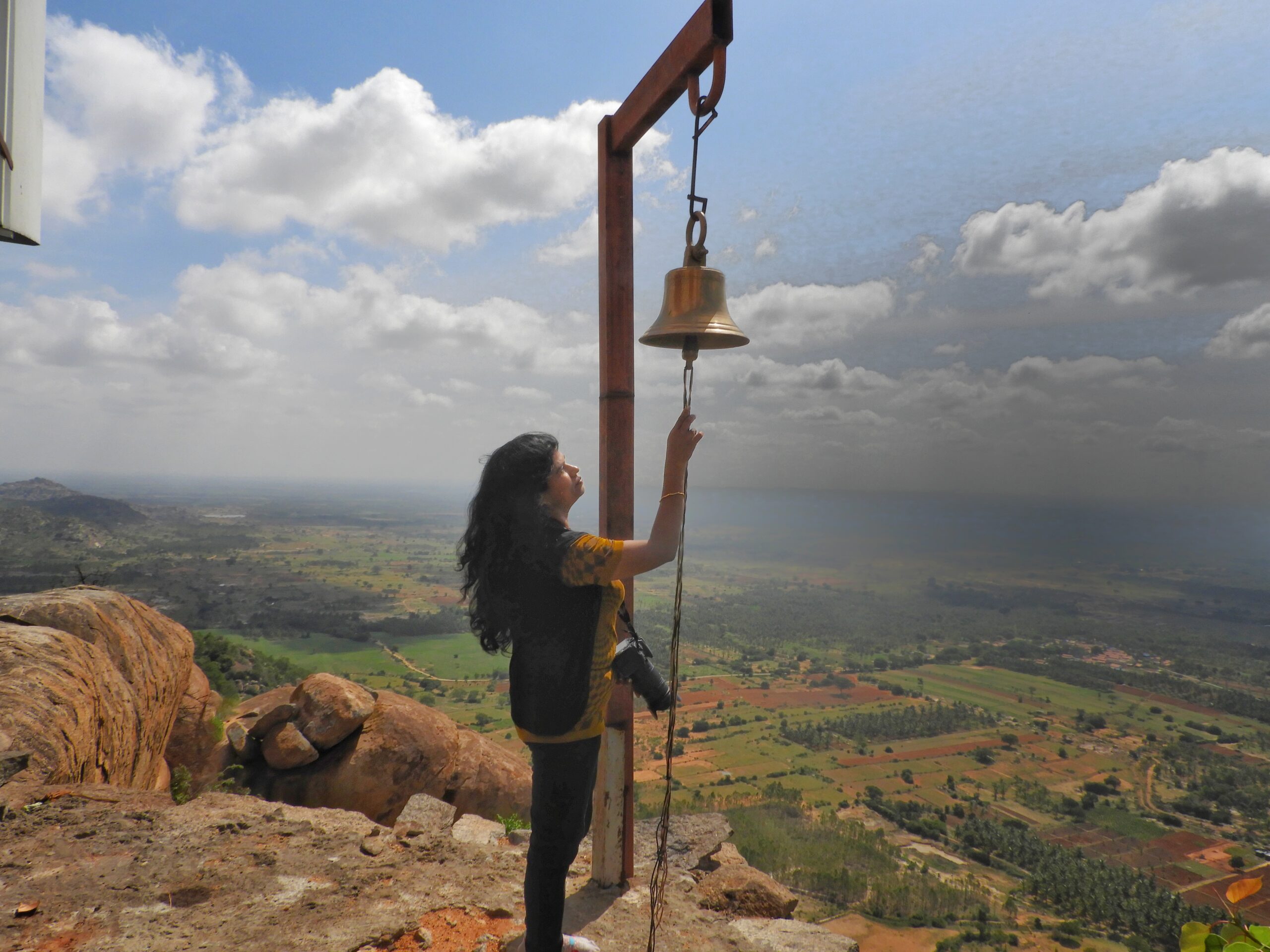
    The atmosphere was calm and peaceful. We sat down on the floor in the temple, after offering our prayers. The sound of the Temple bells ringing was mesmerizing.

    After spending a while we came out and started watching the sky and the surrounding area. The view from the top iwas breathtaking.

    Now all needed was only Egyptian Vulture!!!!!!!
    As a birder I knew this one place I really had to encounter with Egyptian Vulture.
    My prayers were heard. I saw the Vulturesl flying very high in the sky, after a while they landed on a huge rock. Though it was a quite a distance I was happy that I could see them in my camera, and record them. It was a thrilling moment to watch the family. Juvenile vulture with parents. My wishes were fulfilled.


    The heat on the rock was unbearable to stand on, and the Vultures wont come any closer. They vanished in the sky far away. I slowly started to climb down, it was not easy to get down from the hill.
    It took around 1.30 hours to climb  and 30 minutes to come down. Should be more careful while coming down.

    When i Started from home in the morning, only Egyptian Vulture was in front of my mind.  Now i knew it was the whole lot of stories i’was coming back with.