Category: birding trip

  • Indian Eagle Owl ~ Bubo bengalensis

    Introduction

    Indian eagle owl, It is also known as the Rock Eagle Owl or the Bengal Eagle Owl, is a species of owl that is closely related to the European eagle owl (once classified as its subspecies). The Indian Eagle Owl is a fairly large owl with prominent brown ear-tufts. Dark and light morphs of this bird occur. Orange Eyes and Physical Appearance

    As its name suggests – Indian eagle owl can be found across the Indian subcontinent.

    Description

    The facial disc is fulvous-brown to buffy, with a prominent blackish rim. The eyebrows start out whitish at the centre of the face, and change to a blackish line at a point just above the centre of each eye, and then continue up to the dark ear tufts. The forehead is buffy brown, with small blackish flecks, which become greater in number towards the crown, giving it a dark appearance. Eyes are Orange-yellow to orange-red, and the bill greenish-horn to slate-black. The Chin and throat are white. Upperparts are tawny brown, mottled and streaked with blackish brown. There is often a whitish bar across the shoulder. Wing and tail feathers are tawny-buff, barred with blackish brown. Lower parts are fulvous, becoming whitish near the centre. The upper breast has small, dark streaks, with the rest of the underparts having fine streaks and faint cross-bars, which become fainter towards the abdomen. Legs and toes are feathered fulvous, with the outer joints of the toes being bare, and a greenish-slate colour. The claws are dusky black.

    Size: Length 50-56 cm. Wing length 358-433mm. Tail length 185-227mm. Weight 1100g (weight of one male specimen). Females are larger than males.

    Habits: Generally nocturnal. Flies with slow, deliberate wingbeats interspersed with long bouts of gliding on outstretched wings. Usually flies close to the ground. When defending young, adults often resort to diversionary tactics, such as feigning wing injury.

    Voice: Male has a deep, resonant, double hoot bu-whooh, repeated at intervals of several seconds. The female’s song is similar, with a slightly higher pitch. At the nest both sexes with may make a clucking noise, or a series of huwoo-huwoo sounds – again, the female is slightly higher in pitch.

    Hunting & Food: Indian Eagle Owls usually hunt from a perch, but will also make low foraging flights to dive on prey. They primarily hunt rats and mice, but will also take birds up to the size of peafowl. They will also eat reptiles, frogs, crabs and large insects. Pellets are up to 150 x 40mm.

    Breeding: Generally, these owls will breed from February to April, but this may vary locally between October and May.The nest is usually a shallow scrape on bare earth. This may be on a protected rock ledge, river bank, or a recess in a cliff that is in a ravine. They have also been known to nest on the ground under a bush, or between rocks on a slope. 2-4 white eggs are laid, averaging 53.6 x 43.8mm. They are incubated by the female for 35 days.

    Habitat: Rocky Hills with bushes, earth banks, wooded county with ravines, semi-deserts with rocks and bushes. They have been known to inhabit old Mango orchards close to human populations.

    Distribution: West Himalayas, Pakistan, throughout India, Kashmir, Nepal, Assam and Burma.

    Status: Uncertain, not uncommon in suitable habitats.

    Interesting Indian eagle-owl Facts:

    Photo by : Anu Kusumakar Kadri

    Indian eagle-owl inhabits rocky hills, semi-deserts, mango orchards and wooded scrublands.

    People in some parts of India believe that beating of hungry Indian eagle owl can force this bird to speak and predict destiny of its tormentor.

    Despite organized hunting due to false beliefs, number of Indian eagle owls is stable in the wild and this bird is not on the list of endangered animals.

    Indian eagle owl can grow to the height of 19 to 22 inches and reach 39 to 70 ounces of weight. Females are larger than males.

    Upper part of Indian eagle owl is dark colored, covered with brown, black and white feathers. Lower part of the body is pale and covered with dark colored stripes. Indian eagle owls can be lighter or darker colored, depending on the habitat.

    Rapid Growth

    A lot of animals, just like humans, take years to attain the mature size of adults. Indian eagle owls, on the other hand, are pretty speedy in the physical development department. By the time they’re around 10 weeks in age, they usually are adult-sized, though they’re not mature yet.

    The feathers of the Owls help blend them into their habitat and makes them almost impossible to detect in some cases.

    Orange Eyes and Physical Appearance

    One cool Indian eagle owl fact involves their eyes, which have a striking orange coloration that creates a major contrast to the rest of their bodies, which are rather subdued in comparison.

    Other cool aspects of their physical appearance involve the conspicuous brown tufts of feathers on their ears and the white coloration over their throats.

    Indian eagle-owl has a wingspan of 50 to 60 inches. When in the air, Indian eagle owl combines active flying with passive gliding. It often flies close to the ground. Indian eagle owls pretend to have wing injury or fly in a zigzag manner when they want to distract predators and to keep them away from their offspring.

    Indian eagle owl is crepuscular animal (active in the dusk and dawn). Indian eagle owl is a carnivore (meat-eater). Its diet is based on rodents, reptiles, crabs, amphibians and large invertebrates.

    Indian eagle owl does not swallow its prey in one piece. It tears apart its prey before it swallows it.

    Vocalization

    Indian eagle owl produces resonant, loud, two-note “whooo” calls that can be heard at dusk and dawn. During the nesting season, both males and females produce clicks. The signature vocalization of Indian eagle owls is low, full-bodied, clear and ringing.

    Their calls are often associated with misfortune. If a specimen vocalizes from the roof of a residence, it is thought to indicate the upcoming passing away of a member of the household. People believe that Indian eagle owl predicts death.

    Mating season of Indian eagle owl lasts from October to May. Female nests in the shallow scrapes in the ground, or in the rock ledge and river bank and lays 2 to 5 creamy white eggs. Incubation period lasts 35 days.

    Indian eagle owls are covered with white feathers when they hatch. They communicate via clicks and hisses. Young birds spread their wings when they want to trick predators that they are bigger than they actually are.

    Indian eagle owls reach adult size at the age of 10 weeks, but they depend on their parent until the age of 6 months. Indian eagle owl can survive 25 to 30 years in the wild.

    Information source:

    https://www.softschools.com/

    https://www.owlpages.com/owls/species.php?s=1260

    https://en.wikipedia.org/wiki/Indian_eagle-owl

    Original Description: Franklin, James. 1831.

    Proceedings of the Committee of Science and Correspondence of the Zoological Society of London (PZS): Pt. 1, no. 10, p 115.

  • Indian Cliff Swallow Colonial Nesting

    Streak-throated Swallows nesting

    Streak-throated Swallow Commonly known as Indian swallow, Cliff Swallow, Petrochelidon Fluvicola.

    Introduction:

    The streak-throated swallow or the Indian cliff swallow (Petrochelidon fluvicola) is a species of swallow found as Native (breeder, year-round resident or winter visitor) in South Asia in the countries of Afghanistan, Bangladesh, India, Nepal and Pakistan.

    Indian Cliff Swallow is a small swallow with glossy steel-blue colour. The forehead, crown, and back of the neck is chestnut with faint dark streaks. Ventrally white with blackish on side and pale brown rump, and is more prominent in flight. The back is glossy deep blue with a few narrow whitish streaks on head. Underparts are buffy white with blackish-brown streaks, especially the chin, throat, and upper breast. The wings are blackish-brown. Tail is darkest- brown, almost square-ended slightly forked and short. And comparatively weak flight. Sexes are similar. Juvenile is duller and browner than adult, with buff feather edges and faint streaks on underparts. It is resident and partly migratory.

    Cira lake, Tumkuru, Karnataka.

    Colonial nesting involves a number of factors.

    Indian Cliff swallow/ Petrochelidon fluvicola are one of the favorite subjects for behavior ecology studies because of their gourd shaped enclosed structured nest construction behaviour. The nest construction preferably takes place beneath the cliff, under surface of bridges, sloping edges of the man- made constructions, against the gravitational pull. Cliff swallows are good architects and builders in the nature. Cliff swallows use mud for construction slightly reinforcing the organic fibrous contents. Mud is a plastic material that can be molded when wet into required shape & structure on drying it hardens to give a durable shape. Nearly 5% of the bird species use mud as the vital material in nest construction. Mud bear load in compression and in cliff swallows the nests built on rock overhanging are not supported from below. The addition of grass, feather & hair in to the mud probably provides the strength in tension. Mud may vary in its contents. The mud is selected by swallows only when there is a consistency appropriate for building the nest.

    Selection of nest site is an important task in colonial breeding. Birds usually prefer their nesting sites within the foraging site so as to reduce the number of trips to the nest. Closer feeding sites also help in increased vigilance of the nest and minimize chances of predation of eggs and nestlings

    SOCIAL BEHAVIOUR IN NESTING INDIAN CLIFF SWALLOWS

    These gregarious swallows keep in large rabbles in close of water along with other Swallows. All the ordinary activities of Cliff Swallows were performed in groups, and positive social responses were readily seen on the loafing perches, at the foraging areas, at mud and grass-gathering areas, and at the nesting colonies.

    Telephone wires were the commonest perching sites for loafing swallows after seven o’clock in the morning. Habit seemed to be involved in the selection of loafing areas, An hour or so of sun-bathing and preening for out of the many miles of wires accessible to the birds.

    At mud- and grass-gathering areas: The gathering of mud and of grass for the nest was a major activity of Cliff Swallows during the nest building phase of the breeding cycle and irregularly thereafter as nests needed repairing.

    Mud for the nest shell was gathered at rain puddles or along open muddy banks of lakes, streams and sloughs and carried as small pellets in the bill to be added to the nest rim. Grass for the lining was collected in exposed dry spots where the strand was sparse and the grass texture fine. Mud and grass gathering were highly social activities. All participating birds typically concentrated their activity on one or two areas of a few square yards regardless of the extent of suitable facilities in the neighborhood. One or two birds would start the activity by descending to a particular mud site, others would follow, and soon the entire flock would be gathering mud and carrying it back to their nests. From ten to thirty birds might be clustered together in this limited area while dozens more were shuttling back and forth to the nests. Each bird appeared to work independently, holding its wings high above the back and fluttering them as it pecked repeatedly until a large beakful had been secured.

    Collecting the mud usually required 15 to 40 seconds and placing it on the nest from 30 to 40 seconds. The time required to make the commuting flights was determined by the distance, being‘ about 10 seconds for every 100 yards.Nesting Materials.–The availability of mud thus affected the rate of construction. Mud for nest construction was gathered at sites from twenty feet to at least one-half mile from the nesting colony. After rains, almost any puddles close to the nests were utilized, but at other times the birds went farther afield. . Mud collecting was an intermittent activity in which nearly all members of a flock participated as a group. Dried grass for the nest lining was commonly collected near the nesting site. The collecting of this material was, as with the mud, a social activity in which many birds from a flock participated as a group. The period of greatest grass gathering activity was in the early morning before mud gathering had started.

    Territorial threat and fighting were most frequent at partially built nests where a wide entrance meant a relatively large area, to defend or close approximation of neighbouring entrances and many avenues of approach for intruders. That it was this that occasioned the fighting rather than the attainment of a particular stage in the breeding cycle is indicated by the prompt reappearance of intrusion and fighting at nests which had been broken back by the observer.

    The completion of a narrow tunnel entrance apparently served to reduce the occasion for quarreling at the nest. The construction of an enclosed mud shell surrounding the nest proper is a behavioral specialization of considerable theoretical interest. This characteristic, as already suggested, appears to be related to the intense localized territorialism of the species, the shell screening the nesting bird from its numerous close neighbours and thus enhancing social stability in the group.

    The swallow which build their nest first has to keep it’s tunnel entrance extending outward to keep it’s approach to it’s nest accessible. This can be noticed in the above picture

    A comparison of the mud nests of cliff- and ledge-nesting swallows reveals a series ranging in complexity from a simple cup as found in the Barn Swallow to an elongate retort with entrance tunnel such as that built by the Cliff Swallow. Homologous relationships seem to exist through the series: the mud frame or cup has merely been ex-tended upward and outward until the retort form is achieved. Construction in the Barn Swallow and the Cliff Swallow proceeds in a closely similar manner up to the time of egg laying. At this point the Barn Swallow stops while the Cliff Swallow continues to complete its retort and to maintain it in repair.

    Please watch the entire playlist here:

    Indian_Cliff_Swallow #Streak-throated_Swallow #Petrochelidon fluvicola #Nahar Ababil #Bhekhad Ababil: https://www.youtube.com/playlist?list=PL-BYiNWpklmf9o0KKqfskQv-fRAj9eOHQ

    Information collected from these sources:
    1. John T. Ellen, JR www.jstor.org/stable/1364635

    2. Chaya H C et al Int. Journal of Engineering Research and Applications www.ijera.com ISSN : 2248-9622, Vol. 4, Issue 3( Version 1), March 2014, pp.925-930

    Thanks to Devadatha Kumar SR for contributing the photos.

    https://www.jstor.org/stable/1364635

  • Leafbirds – Golden-fronted leafbird

    Golden frontend Leafbird

    The Golden-fronted Leafbirds (Chloropsis aurifrons) are common resident breeder in India, Sri Lanka, and parts of Southeast Asia. They inhabit in deciduous monsoon forests and scrublands.

    Leafbirds were named for the fact that their mostly green and yellow plumages blend in well into their tropical habitat, where the green leaves and bright flowers of the canopy provide a perfect camouflage for these birds. However, leafbirds that are stressed will shed most of their colorful feathers. This adaptation may have evolved as a way of confusing predators, such as snakes. Captured birds under stress will do the same.

    DESCRIPTION

    The adult is green-bodied with a black face and throat bordered with yellow. It has an orange forehead and blue moustachial line, Young birds have a plain green head. Immature birds look like duller versions of the females.
    They have forked, brush-tipped tongues and fairly hefty, straight to lightly down-curved bills with stiff, hair-like feathers at the base that protect their eyes from the legs and wings of their insect prey.

    NESTING / BREEDING

    Leafbirds build open cup-shaped nests out of fine stems, leaf parts and rootlets. These nests are typically placed on the ends of branches near the tree crown; although some may hang from thin horizontal shoots of trees, or they are attached to a pair of vertical twigs. The average clutch consists of 2 – 3 pinkish eggs. The incubation lasts about 14 days and is performed by the female alone, while the male feeds the brooding female. Even though unconfirmed, it appears likely, that the male also helps raise the young.

    Golden-fronted leafbird family Male, juvenile, female

    DIET / FEEDING

    Leafbirds typically forage alone or in pairs in the subcanopy; but some species may occasionally join mixed feeding flocks, while other species defend their feeding territories.

    They feed on mostly insects, as well as taking fruits, berries and nectar.

    Insects: Their long sharp beaks are curved down slightly and a brush tipped tongue, helping them to pick insects from the bark and leaves of trees. They will also pursue flushed prey into the air or down to the forest floor.

    Nectar: Their spiked tongues are well adapted for taking nectar from tubular flowers, such as the Rhabdornis of the Philippines. Like hummingbirds, they will hover in front of a flower while retrieving the nectar. In the process of feeding, the flowers benefit from cross-pollination as the leafbird’s head becomes covered with pollen and spreads from flower to flower. As they move to the next flower, the pollen is deposited on the next flower, which is then able to produce seeds and fruit. Many native plants rely on them for pollination and would not be able to exist without the “services” inadvertently rendered by the leafbirds.

    Fruits: Usually, leafbirds swallow pieces of fruit whole. If this isn’t possible, they will pierce the fruits with their beaks and let the juices leak into their mouths.

    Their attractive songs include various melodious whistles and chatters.

    Information source:

    Species Research by Sibylle Johnson
    https://www.beautyofbirds.com/goldenfrontedleafbirds.html

    Photos courtesy by Devadatha Kumar SR : https://www.facebook.com/dath36

  • Yellow-wattled lapwing Vanellus malabaricus Endemic Bird Photos and notes.

    The yellow-wattled lapwing (Vanellus malabaricus) belongs to the family of plovers, dotterels, and lapwings, Charadriidae.

    The yellow-wattled lapwing species are distributed in India, Nepal, Bangladesh, Pakistan and Sri Lanka. These lapwing species are endemic to Indian subcontinent. These lapwings are monotypic species.

    Appearance, physical description and identification

    Appearance, physical description and identification
    The yellow-wattled lapwing (Vanellus malabaricus)
    is a medium-sized wader, measuring 25 to 30 cm in length and weighing 100 to 200 grams. The wingspan is 65 to 70 cm.

    The yellow-wattled lapwing species have the characteristic, prominent triangular yellow facial wattles at the base of the bill and forehead. There is a black or brownish black crown, separated by a border of thin white band. Excited bird can raise crown feathers.

    In these lapwings, the neck and the upperparts are sandy brown. The rump and the tail are white. Excluding the outer tail feathers, there is a subterminal black band on the tail feathers. The breeding yellow-wattled lapwings have black patch on the chin and throat.

    Yellow-wattled lapwing Photo by Devadatha Kumar SR

    The flight feathers are black and there is a white wing bar on the inner half of the wing. The throat and the upper breast are buff brown. In breeding lapwings, the breast is separated from the white belly by a diffuse blackish band. The rest of the underparts are white.

    The lapwing bill is short and dark gray with yellowish base. The irises are pale brown. The long legs are yellow. The feet extend well beyond the tail while flying. These species do not have hind toes.k

    The juvenile wattled lapwing is a dull version of the adult. The wattle appears small and dull. The chin is white. The cap is pale brown with dark striation. The upperparts may have dark markings.

    The call of these yellow-wattled lapwing species is a descending “ke-oo..ke-oo”, a high pitched repeated “twit.twit.twit” or a sharp “tchee-it” sound.

    Diet and feeding behavior

    The diet of the yellow-wattled lapwing consists mainly of insects. Grasshoppers, crickets, locust, beetles, caterpillars, grubs, mantids, stick insects, spiders, macrobenthic fauna, macrophytes, cereals and grains are their primary food.

    The yellow-wattled lapwing species are mainly terrestrial birds and obligate visual foragers, catching prey from the surface of the ground or from low vegetative cover. The chicks feed on small insects, annelids, cereal, spiders, small frogs, millipedes and small toads.

    Reproduction and breeding habits

    The breeding season of these yellow-wattled lapwing species is from March to May in India. The laying season in Sri Lanka is from March to August. The breeding season is from April to June in Pakistan.

    During courtship, the yellow-wattled lapwing male produces high frequency notes with fully puffed breast. The female in the vicinity responds by repeated short calls. They make fly and dive display, which culminates in mating on the ground.

    These wattled lapwings are monogamous. The male selects the breeding site. The site is usually located on open sparsely vegetated ground in the vicinity of water body. Both the male and female build the nest. The nest is a slight depression on the ground.

    These wattled lapwings are monogamous. The male selects the breeding site. The site is usually located on open sparsely vegetated ground in the vicinity of water body. Both the male and female build the nest. The nest is a slight depression on the ground.

    The typical wattled lapwing clutch contains 3-4 eggs. The eggs are soil-brown with black and creamy blotches. Pebbles and soil balls are accumulated from nearby areas and placed in the nest to provide camouflage to the eggs.

    The yellow-wattled lapwing pair take turns to incubate the eggs for about 28 days. Though the eggs are laid with a difference of a few days, hatching is synchronous. The hatchlings are covered with brown black down feathers, providing perfect camouflage.

    The yellow-wattled lapwing hatchlings are nidifugous and leave the nest soon after hatching. The parents feed the chicks with small insects, spiders, millipedes and earthworms. Parental care goes on for nearly one month.

    The breeding yellow-wattled lapwing pair actively defends its territory from other birds. The parents distract the intruders away from the nest. They also defend their nest from stray dogs, shikra and crows. On warning call from parents, the chicks squat and freeze.

    The parent lapwings may soak their breast feathers at the watering hole and, returning to nest, brood to cool the eggs and chicks with water. A second brood may be raised, particularly when the first fails.

    Migration and movement patterns

    The yellow-wattled lapwing species are non-migratory resident birds. They make short distance movements in rainy season. The movement pattern is not clear.

    Watch video on Yellow-wattled lapwing Vanellus malabaricus in YouTube

    Reference links:

    1.Wikipedia : https://en.m.wikipedia.org/wiki/Yellow-wattled_lapwing

    2. Indian birds : https://indianbirds.thedynamicnature.com/2017/08/yellow-wattled-lapwing-vanellus-malabaricus.html?m=1

    3. Photos courtesy : Devadattha Kumar SR https://m.facebook.com/dath36

  • Amazing birds and truly amazing facts of Birds-Indian Paradise Flycatcher

    Introduction of Indian Paradise Flycatcher

    The Indian Paradise Flycatchers (Scientific Name :Terpsiphone paradisi) They are found  naturally in Asia in extremely large range.
    Indian Paradise Flycatchers are a beautiful bird. Size of adult Indian Paradise Flycatchers are between 18 to 22 cm. The length of the tail (adult male) is between 20 to 24 cm, with two central tail feathers growing up to 30 cm long drooping streamers.  Their wings are between 3.4 – 3.6 inches (86 – 92 mm) long.


           Males paradise flycatcher is found  in two morphs or phases, one have a rufous or glossy chestnut upper plumage and another with a white or dirty white plumage. The edges of the wings and tail feathers are sometimes black.Intermediates of both forms also exist. Some birds also molted from rufous into white plumage.

    Head of Indian Paradise flycatcher is glossy black with a glossy black crown and crest. They have short legs and sit very upright whilst perched prominently. The bill is round and sturdy and bluish black in color. Eyes are black, and the eye rings are bluish black.

          Male Indian Paradise flycatcher have long tail feathers. The long, narrow tail is rounded at the tip, except for the two streamers that droop. This central pair of tail feathers growing up to 20 to 30 cm long drooping streamers. The females are only 20 cm long and lack the tail streamers

    Female are rufous on the back with a greyish throat and underparts, and they have short tail with rufous wings and a black head. Females have greyish throat and underpart, the eyes are black with bright bluish rings around the eyes.

           Young males  lack the two very long central tail feathers, which they acquire in their second or third year.At juvenile stage they look very much like females. Their bodies and wings are rufous and the head, including the throat, is completely black. They have a black throat and blue-ringed eyes.


    Habit and habitat

     They prefer thick forests and well-wooded habitats. They also found in forest, gardens, shady groves, light deciduous jungle, and bamboo ravines. They are migratory and spend the winter season in tropical Asia.

    Distribution
    They found in India, Sri Lanka, and Turkestan to Manchuria and west to the Malay Archipelago where they inhabit the islands of Sumba and Alor. There are resident populations in southern India and Sri Lanka, hence both visiting migrants and the locally breeding subspecies occur in these areas in winter

    Call
      They are quite noisy birds uttering sharp skreek calls. They also call che-che or che-chew or sharp zweet…zweet….
     Food
         Indian paradise flycatcher is a insectivorous bird. They feed on insects, butterflies and flies. They usually hunt in the understory of densely canopied trees.

    Breeding and Nesting

    Indian Paradise Flycatcher are socially monogamous.Nesting and breeding season is between March to July. They make a cup like nest  by twigs bound together with spider webs and is usually situated on the end of a low tree branch. Both male and female take part in nest-building.

          A clutch usually consists of 3 – 4 eggs, which are  pale creamy pink with reddish brown in colour. Incubation for about 21 – 23 days. Both parents take part in hatching, brooding and feeding of the young. The incubation period is between 14 to 18 days. Chicks hatch in about 21 to 24 days.

    All about Indian paradise flycatcher in wild.: https://www.youtube.com/playlist?list=PL-BYiNWpklmcps77-NBz6slJcdgDajCQf

    My encountering these birds, and all my observations are purely from the wild and each film recording spontaneous from nature direct during 2017 – 2020 in my Sunday birding trips in outskirts of Bangalore.

    To make this article more distinct and meticulous, i will be adding Photographs clicked and shared by my batch mate and birding guide, Mr Devadatha Kumar SR(https://www.facebook.com/dath36) . Again, all these photos are captured in the wild nature, outskirts of Bangalore.

    Information source: #https://en.m.wikipedia.org/wiki/Indian_paradise_flycatcher

    photos

  • Into the wild life of Amandava amandava

    This beautiful bird is Red Avadavat, a sparrow sized bird, native to South East Asia. Often kept as a cage bird. The name Amandava or Avadavat are derived from the city of Ahamadabad in Gujarat, India.

    My encountering these birds, and all my observations are purely from the wild and each film recording spontaneous, directly from nature during 2017 – 2020 in my Sunday birding trips in outskirts of Bangalore.

    To make this article more distinct and meticulous, i will be adding Photographs clicked and shared by my batch mate and birding guide, Mr Devadatha Kumar SR. Again, all these photos are captured in the wild nature, outskirts of Bangalore.


    Calling of Red Avadavat- mind blowing….

    In 2017 when i started birding, i asumed like many other birders, that male Amandava is only in scarlet colour, later now i know that it changes plumage in different stages.

    It is very interesting to learn and observe these birds.

    A brief introduction about this bird:
    Amandava – It is also called by many other names. Red Avadavat,Tiger Finch, Amandavade, Red waxbill Avadavat, Indian Strawberry, Scarlet Amandava, Avadavat red Munia, Estrilda Amandava.

    Origin of this Bird:
    They are native to South East Asia
    Their natural range stretches from the Indus Valley of Pakistan to the plains of the Brahmaputra extending south to the peninsula of India.

    Red Avadavat are about 3-4 inches in length. Average wingspan is around 49 mm.

    Red Avadavat at breeding plumage.

    Both male and females moult into breeding plumage each year. During the breeding season, males have a deep red crown and back and there are white streaks under the eyes. The sides of the head, down the breast and the undersides are scarlet. The wings tail or feathers and flanks are dark red with white spots. The tail feathers are black. The beaks of the males are red. When females go into the breeding season, the often moult and the chest and the underbelly becomes brighter yellow orange.

    Courtship, Male inviting female with the feather and acceptance from female.
    Lovely ????

    At the end of the breeding season males begin to moult to plumage that resembles the a coloration of females. The colour of the underbelly ranges from a creamy tan to creamy yellow and there are black streaks under the eyes. The crown, back wings and tail are dark brown with fewer white spots than male in breeding season.

    Juveniles of their species are dull- greyish brown all over. This is the first moult from the nesting stage. Nestlings are marked by dark skin down and have markings around the mouth.

    They habitat in open bush, sugarcane fields, open woodlands, tall and grassy areas alongside bodies of water, edges of cultivation.

    Flocks of Red Avadavat Munia birds under morning sunshine.


    They feed on variety of food sources. They are known mainly as ground feeders. Plant diet includes seeds, grains, nuts, millets. These are omnivorous. Feeds on insects too. When feeding young, they prefer larvae and pupae, centipedes and caterpillars

    Red Avadavat Munia bird flocks together, eat together. Happy hours.
    These were very precious moments of my life too? Loved them watching them enjoying having fun.

    Red Avadavat are monogamous species within a breeding season. They breed once a year. Breeding can occur from January to April. They lay 4 to 6 eggs. Average time for hatching is 11 days. Average fledging age is 20 days.

    Male Red Avadavat use their bright red plumage in addition to mating dance to attract females. The grass stem or feathers in their mouth, deeply bowing with feathers erect. Both male and female display. When the birds have paired, they separate from the larger group to build a nest.

    Male and female nesting behaviour, building a family

    I am Bird watcher, and I’m birding on sundays, what I observed is that as urbanaization taking place rapidly, we are loosing the green patches drastically. Comparatively numbers of birds species have reduced. As lakes around the Bangalore are drying, and land encroachment is increasing rapidly.

    I feel sad that what all these birds I saw within 40-50 Kms distance are no longer there. All the lake beds have turned into housing layouts and high rise buildings. All the natural vegetation have become concrete parks. Only artificial flowers are to be seen.

    All my records of them have been saved in my YouTube channel. If you’re interested to see still more , please check my YouTube channel, and contact me for feedback.

    Follow Devadatha at https://www.facebook.com/dath36

    Information Source : Wikipedia https://en.m.wikipedia.org/wiki/Red_avadavat

  • My quest of Meeting Egyptian Vultures and expiscation of Haddina Kallu Hanumantharaya betta temple.

    My quest of Meeting Egyptian Vultures and expiscation of Haddina Kallu Hanumantharaya betta temple.

    Haddina Kallu Betta ( Eagle stone hill) view from the national highway 75.

    For many years,while traveling From Bangalore to Mangalore (my home town) my eyes would start searching for this huge Arch on the right side after crossing Yadiyur which is the entrance of Haddina kallu betta.

    I heard lots about Egyptian vultures dwelling in Haddina kallu Betta before I had seriously thought of birding, and wanted to see them myself. My birding friends had already visited those places and not keen on visiting again because of the distance to reach there and the amount of hardship to climb the steps-less hill with barefoot. ( you are not supposed to wear footwear because its a temple premisses)

    The urge of meeting the vultures encouraged me to drive a distance of about 100 Km away from Bangalore on my own, one fine Sunday along with my son and that was really an adventurous trip of my life.

    After crossing the flyover at Yediyur, we had to drive for about 7 KMs and look out the signage of “Byrasandra” on the left and for a lovely arch on to the right.

    Taking U-turn We entered  the village road.  A huge arch written “Haddina Kallu Hanumantharaya Swamy Temple”. A arch with figurines of Lord Hanuman and Lord Rama were sculpted on it welcomed you.
    The Byrasandra village was at a distance of four kilometers.
    Driving through the fields, you can see the hill from distance.
    The moment we entered the village road we were greeted by coppersmith barbet, magpie robin,  Indian roller red vented bulbul, Whiskered bulbul, prinia birds, Orange eyed babler, jungle babbler
    bush chats, pied bush chats, indian robin, Brahminy starling, Asian koel, eastern warbler, sunbirds, mynas, parakeet,
    capturing them on my camera and recording the video of them., took more than hour to reach the village.
    As we proceeded, we saw lots of painted storks, grey pelicans, redwattled lapwings, sandpipers, in either side of the road.
    Lush of greenery and vegetation is an ideal place for birds to breed as well.
    The village entrance was very calm and peaceful very clean.
    The black winged kite perched on the wire stopped us abruptly and the background of the hill gave such a classy look. Saw lots of black kites, and brahminy kites.

    Vehicle had to be parked on foothill and walk. First you see the Shrine of Indrajit, the son of Ravana, who’s small statue adorns to the shrine on the right side of the arch. Here, people who have taken a vow sacrifice chicken to the god and cook food from the offering.

    The board at the arch says that we need to leave our footwear at the foothill and climb barefoot.
    Barefoot walking and climbing was challenging. Some stretches of the climb were very steep.
    Climbing the hill in the morning sun was quite a task. No option but to climb in the sun.
    I’m a videographer, and i also click few photos, I had my tripod, Nikon Coolpix B 700 and Cannon DSLR, to click stills, and a bottle of water, with all these started climbing the hill slowly.
    Breath taking scenery all around, stops you often and prompts to capture the beauty of nature.
    One has to  climb about 1050 steep steps to get to the top of Haddina Kallu hill.
    At the top there is a holy pond where pilgrims take a dip before offering prayers to the god.

    Temple was under a shed.

    The temple is dedicated to Lord Hanuman. It is a powerful god for believers. A priest comes from the village to offer pooja everyday. On Saturday and Sunday there are special pooja.
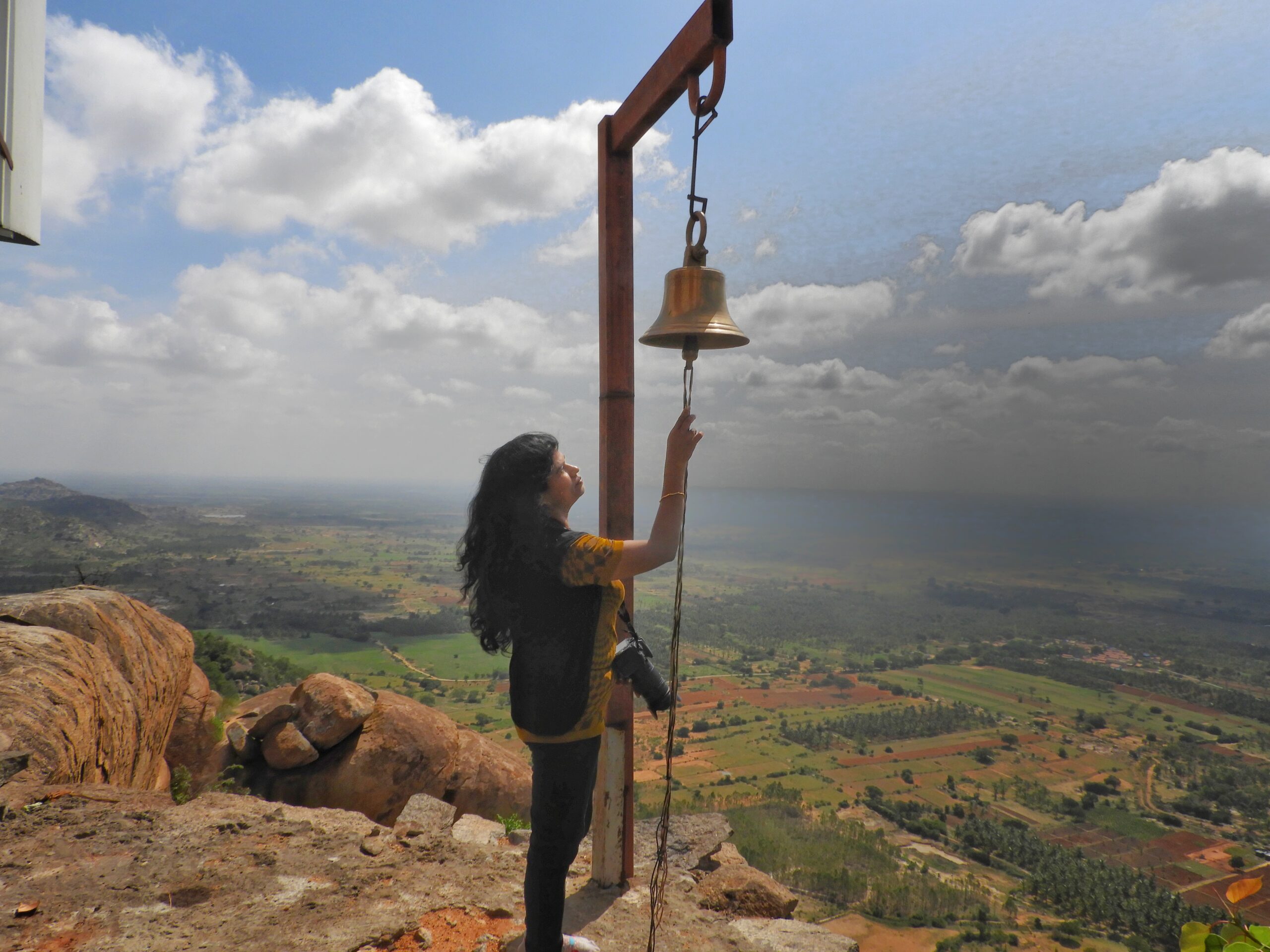
    The atmosphere was calm and peaceful. We sat down on the floor in the temple, after offering our prayers. The sound of the Temple bells ringing was mesmerizing.

    After spending a while we came out and started watching the sky and the surrounding area. The view from the top iwas breathtaking.

    Now all needed was only Egyptian Vulture!!!!!!!
    As a birder I knew this one place I really had to encounter with Egyptian Vulture.
    My prayers were heard. I saw the Vulturesl flying very high in the sky, after a while they landed on a huge rock. Though it was a quite a distance I was happy that I could see them in my camera, and record them. It was a thrilling moment to watch the family. Juvenile vulture with parents. My wishes were fulfilled.


    The heat on the rock was unbearable to stand on, and the Vultures wont come any closer. They vanished in the sky far away. I slowly started to climb down, it was not easy to get down from the hill.
    It took around 1.30 hours to climb  and 30 minutes to come down. Should be more careful while coming down.

    When i Started from home in the morning, only Egyptian Vulture was in front of my mind.  Now i knew it was the whole lot of stories i’was coming back with.