Category: tourism

  • Legendary stories associated with Ahalya and Anusuya

    This is part 2 of another article check here – https://anukusumkadri.9sh.org/2020/06/30/suchindram-thanumalayan-temple/

    There are many legends associated with this temple. Anasuya, the wife of Atri Maharishi was famous for her chastity and her devotion to her husband – an embodiment of a Hindu wife. She could perform miracles by sprinkling the ‘paatha theertham’ (water with which she washed her husband’s feet) to bring rain to a parched earth or to transform objects to her desire.

    When the three Devis, – Goddesses Lakshmi, Saraswathy and Parvathy(athishakthi) heard through Sage Naradha the powers of this earthly woman they wanted to test her chastity. They approached their husbands Lords Brahma, Vishnu and Shiva to test Anasuya’s devotion to her husband. The three Moorthys transformed into three old mendicants and went to the hermitage where Anasuya was living and sought alms from her. When Anasuya was about to serve them food they told her that they had taken a vow whereby they could not accept alms from a person wearing clothes. As it was a sin to refuse alms to mendicants she prayed to her Lord and sprinkled a little ‘paatha theertham’ on the three old beggars. They were all immediately transformed into babies and throwing off her clothes she offered them food.

    The Goddesses learning what had happened pleaded with Anasuya to grant them ‘maankalya biksha’ (gift of married life) and to give them back their husbands. Anasuya showed them the three babies. The Devis ran to the cradle and picked one baby each. Anasuya then prayed to her Lord to restore them back to their original form. Lo and behold! Lord Sri Vishnu was in Lakshmi’s embrace, Siva in Parvathy’s lap and Saraswathy with Brahma. They accepted that Anasuya’s fame as the chastest woman on earth was justified. Thus the Thrimoorthy came to be represented by the Lingam at Suchindram; the bottom represents Brahma, the middle represents Vishnu and the top Shiva.

    There is another lore associated with this temple. Once Indra was infatuated with Ahalya, the wife of Rishi Gautama. One night he came to the hermitage where Gautama was living and crowed like a cock indicating the approach of dawn. Rishi Gautama thinking that dawn was imminent awoke from his sleep and went to the river for his ablutions prior to commencing his prayers. Realising that it was too dark for dawn and too early for morning to break he returned to his hut. In the meantime Lord Indra took the physical appearance of Rishi Gautama, approached Ahalya and satisfied his desire. Rishi Gautama returning from the river was enraged when he saw his wife in another man’s embrace and cursed the man’s entire body be covered with ‘yoni’ (the female organ) and his wife Ahalya to become a statue of stone. Lord Indra in order to get rid of this curse went to Gnanaranya and prayed to the Three Moorthys to rid him of this curse. When he was rid of his curse and transformed into his original form he built a temple and installed the Lingam to represent the three Moorthy – Thanu-Maal-Ayan, and the name of the place came to be known as Suchi-Indran (the place where Indran was purified).

  • Suchindram Thanumalayan Temple

    Amazing architecture, Intricate architecture in stones.

    On my yogic tour to Kanyakumari 2019, I made my visit to this historical temple in Tamil Nadu, south India. This place is a splendid example of architectural miracles, built in the 17th century, known for attracting various pilgrims from across the neighboring states. The legends of Anasuya and Ahalya are attached to the temple. (To read more : https://anukusumkadri.9sh.org/2020/06/30/legendary-stories-associated-with-ahalya-and-anusuya/)

    The Thanumalayan Temple is popularly called as the Sthanumalayan Temple. Also known as the Suchindram Anjaneyar temple, or Sri Dattatreya temple, is an important Hindu temple located in the city of Suchindram in Kanyakumari district of Tamil Nadu. this temple is of importance to both Shaivaite and Vaishnavite sects of Hinduism.

    The name Stanumalaya denotes Trimurthis. “Stanu” means Shiva; “Mal” means Vishnu; and “Ayan” means Brahma.
    There are two temples within the premises. The smaller temple is from the 9th century AD and the second temple was built later by the rulers of this region, including the Kerala King Marthanda Varman. The temple’s art and architecture is of the Dravidian style.
    The Huge temple complex covers around two acres and has two gateway towers known as gopurams. The taller of two is the eastern tower, with eleven stories and a height of forty four metres (144 ft).
    The temple has a huge Gopura which rises to a height of 134 feet and has a number of small deities. Many huge pillars made of single stone are additional attractions. There are pillars with musical notations too.

    At the beginning you can see Dakshina moorthy, then proceed to see other temples . The three deities Bramha, Vishnu and Maheshwara is carved on a single stone and worshipped here. There is a 200 year old tree behind this ‘thrimoorthy’ idol. The trunk has been plated to preserve it from decaying. There are Nandi, Shiva, Nataraja, Navagraha and Vishnu temples too.
    There is a temple of Lady Ganapathi known as Ganeshwari, which is not seen elsewhere.
    There is an Anjaneya(Hanuman) statue which stands at twenty two feet (6.7 m) and is carved of a single granite block. It is one of the tallest statues of its type in India (62 ft).

    Photo courtesy: Google search


    Opposite to this statue there is Rama and Sita temple, Sendai melam pillar, and a statue with hollow ears where a straw can be passed through them.
    You can see the temple of Ganesha and take a walk around the pillared halls to enjoy one of the most amazing creations of anciet architecture.

    The special features of the temple include the four famous musical pillars, each formed by a group of smaller pillars, all carved from a single stone. Two of these large pillars have thirty three smaller pillars and the other two have twenty five each. Each of these smaller pillars produce different musical notes of Sa, Re, Ga, Ma, Pa, when tapped. Unfortunately these pillars are surrounded by iron grills to prevent vandalism.

    The place got the name of Suchindrum from the Sthala Purana. A Hindu mythological legend has it that king of the devas, Indra, got relieved of a curse at the exact place of the main linga in the temple. The term “Suchi” in Suchindrum is believed to be derived from the Sanskrit meaning that stands for “purify”. Accordingly, Lord Indra is supposed to visit the temple for performing “Ardhajama Pooja”, or worship, at midnight every day.

    There are many priests who come forward to guide tourists. You can hire any one of them to enlighten you as this temple has plentiful history which is worth knowing. The one who guided us explained in kannada, telugu and hindi. Overall, it was a really good experience..

    Entry to the temple is free to all. Special ‘Darshan’ costs an amount of Rs 250 per person. Required dress code: males must remove their shirts and enter the temple bare chested. Females may wear saree/half saree/churidhar with upper cloth. Prasadam is served to all.
    Photography is not allowed. The cameras can be handed to the security for a fee of ten rupees(at your own risk) before entering the temple.

    The pond is so huge, and peaceful.
    This is definitely a place that has to be on your list if you are visiting Nagercoil/Kanyakumari.
    It is about 13 km distantce from Kanyakumari. You surely won’t regret a tour of this beautiful establishment. There are memories worth making.

    watch the video to know more about the temple

    https://anukusumkadri.9sh.org/2020/06/30/legendary-stories-associated-with-ahalya-and-anusuya/

    Additional information has been taken from Wikipedia : https://en.wikipedia.org/wiki/Thanumalayan_Temple

  • My quest of Meeting Egyptian Vultures and expiscation of Haddina Kallu Hanumantharaya betta temple.

    My quest of Meeting Egyptian Vultures and expiscation of Haddina Kallu Hanumantharaya betta temple.

    Haddina Kallu Betta ( Eagle stone hill) view from the national highway 75.

    For many years,while traveling From Bangalore to Mangalore (my home town) my eyes would start searching for this huge Arch on the right side after crossing Yadiyur which is the entrance of Haddina kallu betta.

    I heard lots about Egyptian vultures dwelling in Haddina kallu Betta before I had seriously thought of birding, and wanted to see them myself. My birding friends had already visited those places and not keen on visiting again because of the distance to reach there and the amount of hardship to climb the steps-less hill with barefoot. ( you are not supposed to wear footwear because its a temple premisses)

    The urge of meeting the vultures encouraged me to drive a distance of about 100 Km away from Bangalore on my own, one fine Sunday along with my son and that was really an adventurous trip of my life.

    After crossing the flyover at Yediyur, we had to drive for about 7 KMs and look out the signage of “Byrasandra” on the left and for a lovely arch on to the right.

    Taking U-turn We entered  the village road.  A huge arch written “Haddina Kallu Hanumantharaya Swamy Temple”. A arch with figurines of Lord Hanuman and Lord Rama were sculpted on it welcomed you.
    The Byrasandra village was at a distance of four kilometers.
    Driving through the fields, you can see the hill from distance.
    The moment we entered the village road we were greeted by coppersmith barbet, magpie robin,  Indian roller red vented bulbul, Whiskered bulbul, prinia birds, Orange eyed babler, jungle babbler
    bush chats, pied bush chats, indian robin, Brahminy starling, Asian koel, eastern warbler, sunbirds, mynas, parakeet,
    capturing them on my camera and recording the video of them., took more than hour to reach the village.
    As we proceeded, we saw lots of painted storks, grey pelicans, redwattled lapwings, sandpipers, in either side of the road.
    Lush of greenery and vegetation is an ideal place for birds to breed as well.
    The village entrance was very calm and peaceful very clean.
    The black winged kite perched on the wire stopped us abruptly and the background of the hill gave such a classy look. Saw lots of black kites, and brahminy kites.

    Vehicle had to be parked on foothill and walk. First you see the Shrine of Indrajit, the son of Ravana, who’s small statue adorns to the shrine on the right side of the arch. Here, people who have taken a vow sacrifice chicken to the god and cook food from the offering.

    The board at the arch says that we need to leave our footwear at the foothill and climb barefoot.
    Barefoot walking and climbing was challenging. Some stretches of the climb were very steep.
    Climbing the hill in the morning sun was quite a task. No option but to climb in the sun.
    I’m a videographer, and i also click few photos, I had my tripod, Nikon Coolpix B 700 and Cannon DSLR, to click stills, and a bottle of water, with all these started climbing the hill slowly.
    Breath taking scenery all around, stops you often and prompts to capture the beauty of nature.
    One has to  climb about 1050 steep steps to get to the top of Haddina Kallu hill.
    At the top there is a holy pond where pilgrims take a dip before offering prayers to the god.

    Temple was under a shed.

    The temple is dedicated to Lord Hanuman. It is a powerful god for believers. A priest comes from the village to offer pooja everyday. On Saturday and Sunday there are special pooja.
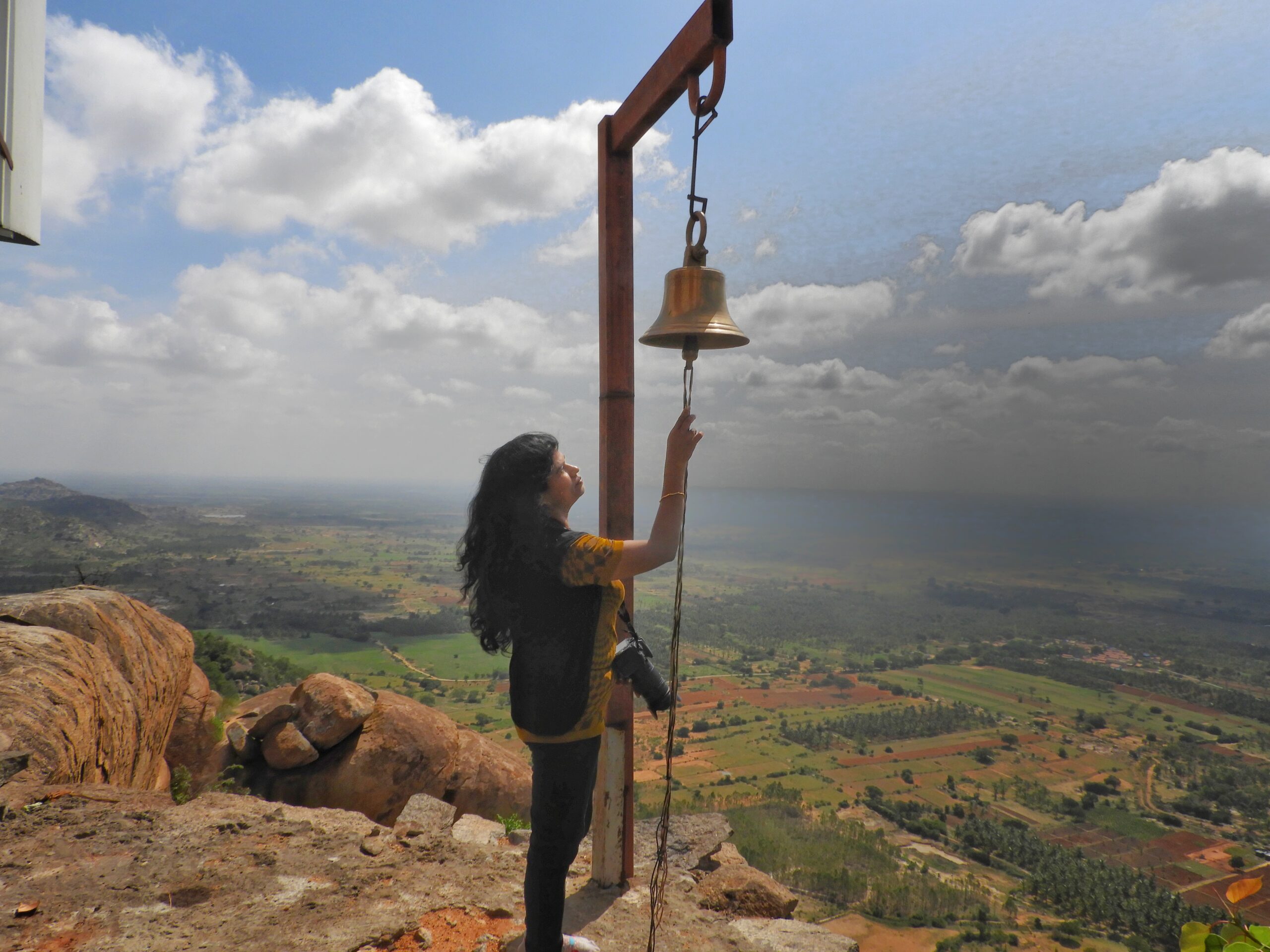
    The atmosphere was calm and peaceful. We sat down on the floor in the temple, after offering our prayers. The sound of the Temple bells ringing was mesmerizing.

    After spending a while we came out and started watching the sky and the surrounding area. The view from the top iwas breathtaking.

    Now all needed was only Egyptian Vulture!!!!!!!
    As a birder I knew this one place I really had to encounter with Egyptian Vulture.
    My prayers were heard. I saw the Vulturesl flying very high in the sky, after a while they landed on a huge rock. Though it was a quite a distance I was happy that I could see them in my camera, and record them. It was a thrilling moment to watch the family. Juvenile vulture with parents. My wishes were fulfilled.


    The heat on the rock was unbearable to stand on, and the Vultures wont come any closer. They vanished in the sky far away. I slowly started to climb down, it was not easy to get down from the hill.
    It took around 1.30 hours to climb  and 30 minutes to come down. Should be more careful while coming down.

    When i Started from home in the morning, only Egyptian Vulture was in front of my mind.  Now i knew it was the whole lot of stories i’was coming back with.